
09 ENE – 05 FEB
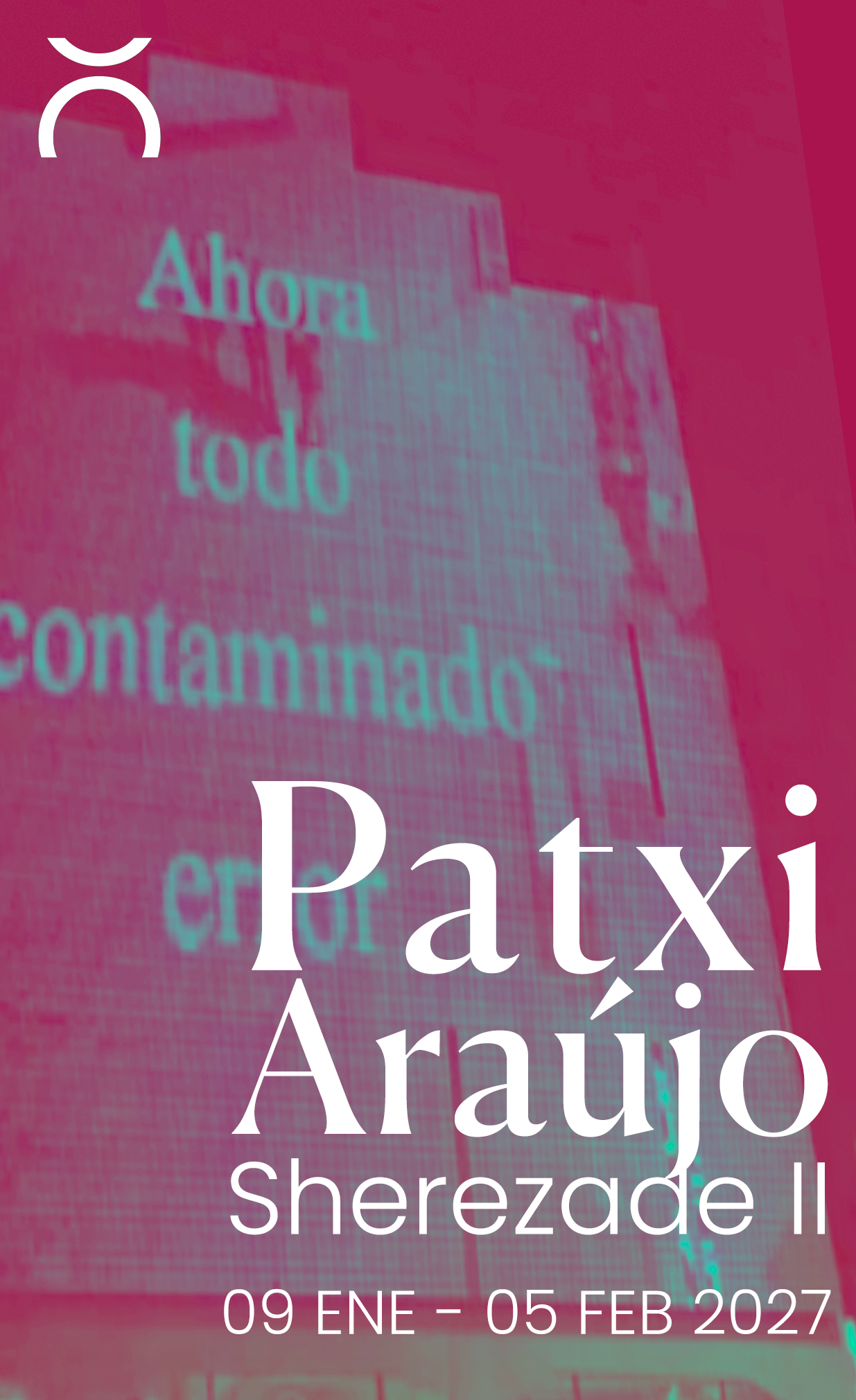
OBLIQUO presents Sherezade II by Patxi Araújo, curated by Mario Gutiérrez Cru. The interactive piece was originally conceived for the now-disappeared façade of Medialab Prado, where activity in the square directly influenced the generation of texts. The work originated in 2020 through a commission from Art Madrid to PROYECTOR.
For its presentation at OBLIQUO, the work has been revised and reactivated within a new urban context. Updated software and hardware allow Sherezade II once again to respond to the presence and movement of those passing in front of the space: both viewers who deliberately approach the work and pedestrians who, without realising it, enter its writing mechanism for a few seconds.
The piece thus transfers its original logic to Carabanchel, turning the everyday flow of the street in front of the window into an active part of the work.
The starting point of Sherezade II lies in Las causas (The Causes) by Jorge Luis Borges. The poem builds an extensive enumeration of events, objects, places and times that ultimately justifies itself through a single encounter: “all these things were required / so that our hands might meet.”
Patxi Araujo transfers this idea of poetic causality into a writing machine. Within a predefined grammatical structure, 3,796 words remain stored, waiting to be combined. A slight change in light, the appearance of a person, an animal, or any variation detected in front of the work may intervene in the selection of terms and trigger a new sentence.
Whether the result responds to pure chance or to a sophisticated form of determination depends, as the artist himself suggests, on how we choose to interpret it. Between these two extremes lies the play of Sherezade II: words that might behave like dice end up articulated within a syntax and suddenly seem to say something.
Each sentence is a statistical coincidence open to a possible poetic reading. A finite database produces an enormous number of combinations and, through them, an even greater number of associations, memories and interpretations.
For a few seconds, a sentence acquires presence, appears to assert itself as definitive and demands our attention. It then disappears, and its words return to the undifferentiated set from which they emerged, once again available for other encounters.
The machine, however, understands none of these sentences.
And perhaps this is where one of the work’s most interesting contradictions lies. Opposite the system’s inability to understand what it produces stands our extraordinary ability to project meaning, establish relationships, find metaphors or construct small narratives even where there is only a combination of terms.
But Sherezade II does not speak only about what we are capable of doing with language. It also raises the reverse question: what language does to us.
The available words condition the possible sentences. The grammatical structure defines what can be formulated. The mechanism appears to offer enormous combinatorial freedom, and yet every one of its possibilities is contained in advance within a vocabulary and a set of rules.
Something similar happens with our own thought.
The viewer intervenes in the work, but never fully controls what they set in motion. A presence, an absence, a casual movement in front of the window may become the remote causes of a sentence no one had anticipated.
Sherezade II thus transforms the everyday movement of the street into a form of involuntary writing. Between the body that passes, the program that selects and the person who finally reads, a brief coincidence appears.
A sentence that could only exist because, somehow, all these things were required for those words to meet.
OBLIQUO
Calle Alejandro Sánchez 94, Madrid.
Monday to Sunday from 9am to 9pm.

Sherezade II
2026
(All those things were required for our hands to meet)
J. L. Borges’s poem The Causes[1] is a litany that ultimately becomes an inventory of the ingredients required for a final encounter, an exercise in poetic causality. Its final two lines thus declare how, after naming them one by one, all those things were required / for our hands to meet.
Here, following a grammatical structure similar to that of the poem, 3,796 words are combined with no semantic rigour beyond the opportunity afforded by a slight change in light or the appearance of a human or animal passer-by, or of an object. Whether this occurs through pure chance or through the exquisite determination of fate is a matter of taste, but it is ultimately what decides between the words dancing like dice and the syntax that articulates them.
Each sentence generated presents a possible statistical coincidence, open to improbable poetic connections: a (finite) database of words produces a (grotesque) number of combinations, which in turn points towards an (astronomical) number of evocations.
After their moment of glory, they all return to the unanimity of the unconjugated — or, in other words, to the sheer potential of their encounter.
The machine’s inability to understand the meaning of its sentences is not only comparable to our human ability to dream meanings into them, but also to our inability to escape the limits of predictable metaphor, the crust formed by the routines of logical reason.
It speaks of what we are capable of through language, but also of how language constrains us, of how it structures our thought.
[1] Historia de la noche, 1977
Patxi Araujo
Patxi Araujo
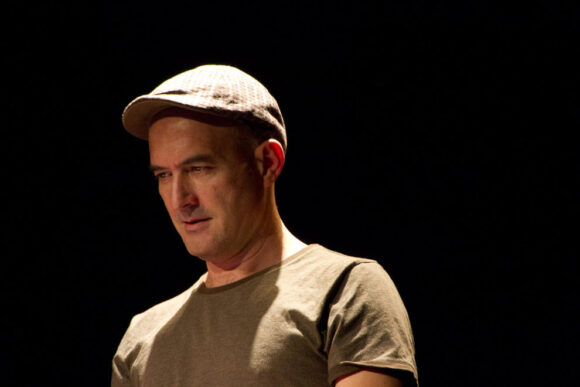
Patxi Araujo (Spain, 1967)
Artist and Professor at the Faculty of Arts at the University of the Basque Country UPV/EHU. Departament of Art and Technology.
Being his background the fine arts practice, his work takes place in the territory of the poetics of new-media, as an aesthetic alibi to face the technological-digital. His early works were incursions into the territory of interaction and techno-magic. He has also developed spaces, objects and subjects based on the research of the interface concept. Now his investigation focuses on software entities and physical environments, around the concept of the human and nature through bodies, perceptions and metaphors related to programming, artificial life or simulation. His work has been recognized and selected in different biennials, festivals and contests of both video art and electronic experimentation.